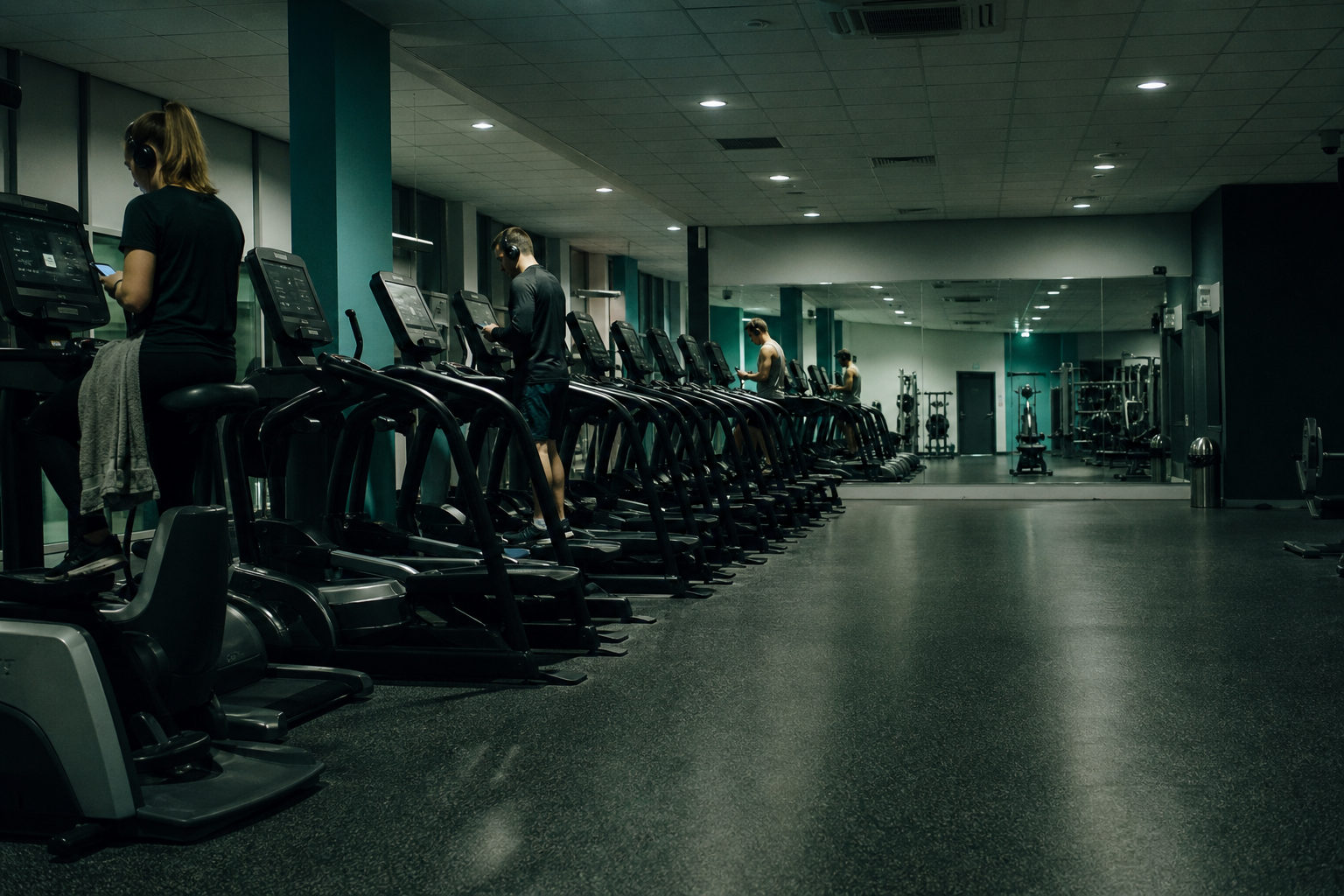
The gym is lonely. Why a generation is choosing sport instead.
For most of the last fifteen years, the gym was where Britain went to feel healthy. Quietly, over the last three or four, that's stopped being true. The reasons aren't the ones the fitness industry talks about.
The gym had its decade
The gym is the loneliest building on most UK high streets, and for a long time that was the point.
The 2010s were the decade we all signed up. Pure Gym opened sites quicker than coffee chains, David Lloyd added pools and saunas and yoga studios and called itself a club, and Planet Fitness arrived from the States with the £15 monthly contract that turned exercise into something you opted into without thinking too hard. By 2019 something close to one in seven UK adults had a gym membership and a few of us actually went.
The pitch worked because the gym solved real problems. You could go alone. You could go at 6am or at 11pm. You could measure your progress on a leaderboard with yourself. There was no team to coordinate or pitch booking to chase, no captain texting you on Sunday night to ask if you were good for Tuesday. You paid your direct debit and the responsibility ended there. Convenience built the industry.
What it never solved was being around other people. You'd go in alone, put your earphones in, do your sets and leave. You could do that five times a week for three years without learning the name of a single person who worked out at the same time as you. Plenty of us have. Plenty of us still do.
The pandemic pulled the rug. When the gyms shut in 2020 a lot of us discovered Peloton and Joe Wicks and the home workout, and a lot of us discovered we hated it after about six weeks. The thing nobody quite said out loud was how flat the whole experience felt. We'd been told what we wanted was convenience. What we'd been missing was the room.
The numbers stopped lying
Then something started shifting around 2022, slowly enough that you could miss it if you weren't paying attention. It showed up first in the data, but the data points all said roughly the same thing. People were leaving the gym, and they weren't going home. They were going to find each other.
Run clubs registered on Strava hit around one million globally by the end of 2025 — roughly four times the number from a year earlier. UK padel court demand increased by around 300% between 2022 and 2025, with new clubs being built in old warehouses across north London and months-long waitlists. Around 73% of group sport participants say their primary reason for showing up isn't fitness — it's the company. And Gen Z is now the fastest-growing demographic on Strava, using the social features more than the tracking ones.
London run clubs that were sub-cultural ten years ago — like Run Dem Crew and November Project London — now pull three-hundred-strong meet-ups on a Tuesday morning. Some have memberships you have to apply for. Five-a-side leagues that had been contracting for a decade are reporting record demand again: Powerleague, Goals, the independent operators in the arches under railways. All back, all booked.
The signal in all of this isn't really about fitness. It's that something like seven in ten people who play group sport say the reason they keep showing up isn't getting fit. It's who they're showing up with. The gym sold us individual progress. What it turns out a lot of us actually wanted was a regular Thursday with people who'd notice if we didn't turn up.
Why sport bonds people and the gym never could
Robin Dunbar, the Oxford anthropologist who's spent forty years studying how human friendships form, has a useful frame for this. He argues there are three preconditions for a real friendship to take root: physical proximity, repeated unplanned contact, and a context where you can let your guard down.
The gym gives you the first one and almost nothing else.
Sport, almost incidentally, gives you all three. You're standing six feet from the same eight people every Thursday at half past six. You see them sweaty, swearing at the ref, missing open goals. They see you do the same. Forty minutes in, the social armour's gone. There's no version of yourself you can credibly perform when you're winded and your team's losing 4–1.
Dunbar has pointed at something more specific too. The endorphins your body releases when you move in coordination with other humans aren't quite the same chemistry as the endorphins from a solo run. The bonding effect is real, it's measurable, and it's a feature of the activity rather than the mood. A choir does it, a dance class does it, a five-a-side does it. Jogging on a treadmill watching the calorie counter tick up does not.
It's also why the rare friendships that do form in gyms tend to form in the smoothie queue, not the squat rack. The whole architecture of the gym is built around the assumption you're there alone. You buy access to equipment and you use it, done. The architecture of a recurring sports game is built around the opposite assumption: that the same people will turn up next Thursday, and the Thursday after, until eventually they aren't strangers any more.
The gym: a transaction. You buy access to equipment. The same people show up at the same times and you never speak to them. Progress is measured against yourself. You can drop the membership tomorrow and nobody notices.
A weekly sports game: a relationship. You turn up because seven other people are expecting you. Forty minutes of shared effort dissolves the social armour. Progress is measured by whether the team plays better together. Drop out and someone messages you Friday morning.
That distinction matters because of retention. People let their gym membership lapse all the time. They don't let their five-a-side lapse. The thing they're getting from the second one is something the first one never really offered.
What this actually means for how you train in 2026
None of this is an argument against the gym. The gym still does what the gym does well. If what you want is to lift heavy things at 6am while listening to a podcast, no five-a-side is going to give you that.
What's worth noticing is that for most of us the gym was never really about lifting heavy things. It was about being healthy and feeling like we were doing something with our lives, and we picked the gym because it was what was available and easy. If a quiet majority of British adults under forty are now picking sport instead, the question is what's actually being chosen. It isn't a different way to burn calories. It's a different way to spend a weeknight.
A player I spoke to recently summed it up better than I could have: "I had a gym membership for three years. I went forty times total. I've played football every Thursday for six months and I've missed twice."
There's no fitness story in that. There's a story about what your week starts to belong to once you commit to a thing with other people in it. The gym was something he paid for. The football is something he turns up to.
The shift everyone's reporting — Strava, the run clubs, the padel court bookings, Sport England's surveys — is essentially this realisation, scaled up. The gym replaced the pub as the wellness venue of the 2010s. Run clubs and weekly games are replacing the gym as the wellness venue of the second half of the 2020s. None of these places ever really sold fitness. They sold a place to be on a Wednesday night.
This is roughly the gap Fittrybe was built to fill. Not as another fitness app. As a way to actually find the recurring local game that turns into your Thursday. It's the same logic the run clubs and padel courts have been quietly riding for the last few years, with infrastructure built around it.